

Health System Transformation Through EMS Data Integration – for Policy Makers
Emergency Medical Services (EMS) data represents a critical, yet underutilized, resource with significant potential to transform public health surveillance, support the delivery of health and social services, and improve health outcomes. Investing in the integration of this near real-time data source will provide visibility into patient needs that remain hidden in traditional clinical settings, driving better care coordination, efficiency, and …
Read more >
Incorporating Community Voice into a Statewide Initiative, Experiences from the Field
In 2020, the Center for Medicare & Medicaid Services (CMS) awarded the Michigan Department of Health and Human Services (MDHHS) a five-year project to enhance data exchange capabilities and reduce health disparities in Michigan. The Center for Health and Research Transformation (CHRT) joined as a partner to support 7 regional health collaboratives and facilitate a learning community. The project recognized …
Read more >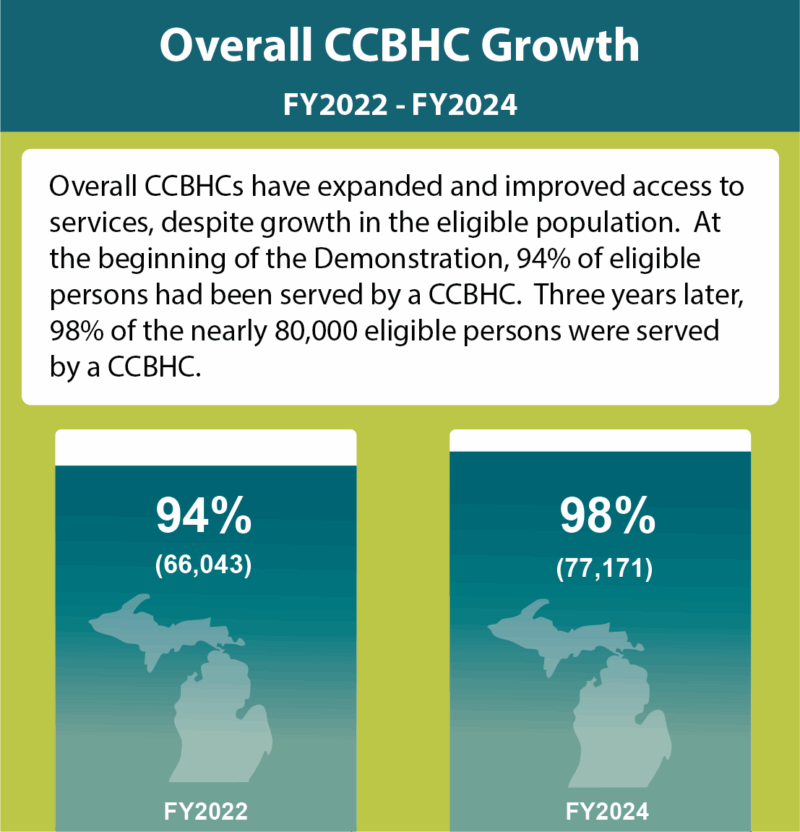
Certified Community Behavioral Health Clinics in Michigan: Early Results
Certified Community Behavioral Health Clinics (CCBHCs) are non-profit organizations or units of a local government behavioral health authority designed to provide comprehensive, integrated mental health and substance use disorder (SUD) services to anyone who walks through their door, regardless of their diagnosis, insurance status, ability to pay, or residence. The Michigan Certified Community Behavioral Health Clinic (CCBHC) Demonstration launched on …
Read more >
Pharmacy Benefit Managers (PBMs): A brief for legislators
Pharmacy Benefit Managers (PBMs) are powerful intermediaries between drug manufacturers, pharmacies, insurers, and patients. They negotiate rebates and manage prescription benefits for nearly all Americans with drug coverage. While PBMs were created to streamline claims and control costs, concerns have grown about opaque pricing, market concentration, and their impact on patients and independent pharmacies. Key Findings 1. What PBMs do …
Read more >
The 340B drug pricing program in Michigan: A brief for legislators
The federal 340B Drug Pricing Program allows safety-net providers to buy outpatient drugs at reduced prices and reinvest the savings to serve low-income and uninsured patients. In Michigan, hospitals, clinics, and community health centers use these funds to sustain vital services—from behavioral health and maternity care to discounted prescriptions. While widely used, the program continues to draw debate around transparency, …
Read more >
Certified Community Behavioral Health Clinics in Michigan: Expanding Access to Behavioral Health Services
The Michigan Certified Community Behavioral Health Clinic (CCBHC) Demonstration is an initiative designed to expand access to community behavioral health services and improve Medicaid reimbursement. Michigan joined the federal Demonstration on October 1, 2021, with 13 initial sites, following authorization by the CARES Act of 2020. The program was later extended to a six-year demonstration, set to end in September …
Read more >
Access to health care in Michigan: A brief for legislators
The Center for Health and Research Transformation (CHRT) has released an issue brief focused on access to health care. The brief, titled “Access to Health Care in Michigan,” describes barriers that affect health care access in the state. Health insurance coverage is a central element improving access to care, but insurance coverage alone is not sufficient to ensure access. This …
Read more >
85% of Michigan physicians blame admin burden for rising stress and burnout
Physician burnout is a critical issue threatening both the stability of Michigan’s healthcare workforce and the quality of care that Michiganders receive. It is also a driving force behind staff turnover and decreased productivity in the state. These issues extend beyond staffing concerns, impacting both the quality and experience of care. Research has found clear links between physician burnout and …
Read more >
When Doctors ask patients about social needs, do they know where to send patients for help?
Since 2018, the Center for Health and Research Transformation (CHRT) has been surveying primary care physicians (PCPs) across Michigan about their experiences screening patients for health-related social needs and referring them to community-based resources for support. In this report, we examine how social needs screening and knowledge about where to refer patients has changed from before the pandemic (2018), to …
Read more >
The benefits of dental health
Increasingly, researchers are illuminating the benefits of dental health. Oral health impacts overall health and dental care is vitally important to curb chronic conditions and improve the systemic health of patients. In this publication by CHRT and Blue Cross Blue Shield of Michigan, CHRT’s health policy team analyzes peer-reviewed clinical research to understand the benefits of dental health for whole …
Read more >